
Membranes
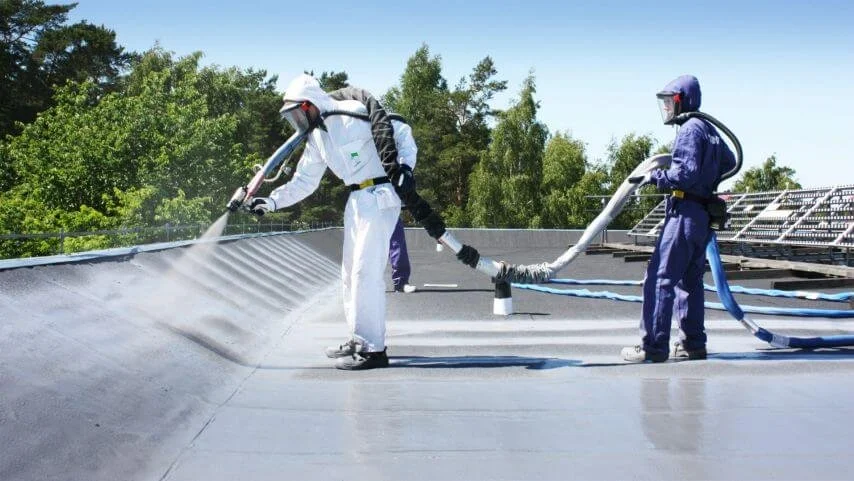
Membranes are the very partitions we rely on to keep our assets protected. Membranes come in a variety of different types. They range from liquid to sheet and in situ to preformed. The range is vast and encompasses a vast array of use case scenarios.
The importance of membranes, their selection, and application serves the most critical part of waterproofing systems in any setting. Waterproofing systems centre around the chosen membrane to suit the application requirments with many overlaps to allow for selection.
Polyurea
Polyurea is arguably one of the most advanced protective coating systems available. Polyurea is a coating applied by a plural spray machine spraying at pressures between 2200-2500psi at a ratio of 1:1. Polyurea is made up of isocyanate (part A) and resin (part B). The plural component spray equipment uses heat to dilute and create similar viscosity in each component to achieve a consistent 1:1 ratio.
Most interestingly, Polyurea was developed before the equipment used to apply it. Polyurea has some impressive qualities that make it a real standout in the protective coating world. The coating dries in a matter of seconds making it impervious to the elements. Polyurea exhibits outstanding qualities such as high tensile strength, elongation, chemical resistance, fire resistance, impact resistance, water resistance and much more. The chemistry can be altered to produce more or less of the above qualities making it suitable for a wide range of critical applications.
Some of these applications include, waterproofing, chemical containment bunding, corrosion protection, increasing asset and structural integrity and much more. Utilized in the toughest industries such as mining, infrastructure and the likes polyurea minimises downtime in application and cure times creating faster turnaround with a product that can withstand more than most could throw at it.
The downside to Polyurea is more to do with the difficulty of application and intricacies of its chemistry.
Epoxy/Polyspartic
Epoxy and polyspartic coatings, similar to polyurea, are two component and made up of both isocyanate and resin – part A/part B. The similarities end here. The outcomes with epoxy and polyspartic vary depending on the nature of the application. Epoxy coatings have long been the choice for both performance in demanding environments and appeasing aesthetic design and decoration. Epoxy coatings are used to coat flooring in areas such as warehouses, showrooms, factories and are chosen because they are hard wearing rugged and rigid averting potential for the like of physical damage, hot tyre pickup and the likes. The working time allows for the creation of artistic and aesthetic finishes. The downside to this working time is the coating is more sensitive to moisture, oils and greases found in the substrate.
Polyspartic is used in mostly the same areas but has some qualities that set it apart from epoxy. Unlike epoxy, polyspartic coatings have faster cure times and have more elongation making it more suitable to applications that expect movement. This creates disadvantages in the ability to be creative in the finish though beautiful coatings re very much possible with polyspartic.
Polyurethane
Polyurethane coatings have long been the mainstay for waterproof coatings and for several reasons. Polyurethane coatings are single component making them easy to use. They are either solvent or water based in nature. Solvent based polyurethane membranes allow for a higher solids content making for a more robust membrane. Polyurethane coatings are high in elongation and ease of use, being a single component membrane, making it a staple in construction waterproofing. Some advantages to solvent based polyurethane is that it is less affected by inclement weather during the curing phase due to it’s higher solids content and faster drying times. While this is a benefit in one aspect it does make the membrane more sensitive to substrate moisture.
Polyurethane has excellent thermal and UV resistance making it a great choice for external weather and waterproofing.
Latex
Latex membranes are the most common and easily accessible waterproof membranes. They are water based and generally the benchmark for most internal and general waterproofing requirments for construction. I would describe this coating as the jack of all trades. The benefit with membranes of this nature is that they are easily accessible, easy to apply and often represent the minimum in compliant waterproofing membranes.
The disadvantage with this membrane is that it does not do well in anything less than ideal circumstances such as substrate and external moisture and temperature. This is due to it being lower in solids content and being water based.
Bituminous
Bituminous membranes come in both liquid applied and sheet applied membranes. The basis of which is asphalt, petroleum based, mixed in with aggregates such as polyester or glass for strength and naturally is impervious to water and flexible.
Bitumen membranes have been traditionally used both below ground and above ground in critical applications such as roofing, basements and the likes.
Bitumen membranes are easily accessible and cost effective making it a great choice.
Sheet membranes will typically require specialist installation as the most critical aspects of this membrane is found in the joins, corners and seams requiring careful detailing to make for a watertight finish. This is done by using heat to melt and activate the bitumen sheet membrane to adhere to the substrate and all corners and overlaps. It requires and origami like approach with careful sequencing.
Sheet Membranes
Sheet membranes are made up from a plethora of materials making it suitable for a wide array of use case scenarios. These include bitumen, bentonite, butyl rubber, thermoplastic and more. There are various methods of installation such as heat, chemical priming and mechanical fixing.
The main benefit to sheet membranes being that they are manufactured and have a level of quality control beyond most other membranes. This means there are consistently repeatable waterproofing outcomes leaving room for less variation such as substrate and external elements like weather and subsequent use.
Sheet membranes have been traditionally used in applications such as, roofing, basements, retaining walls and the likes.
Sheet membranes are reasonably accessibly yet require specialty application due to some of the techniques involved and equipment involved.
The main advantages to sheet membranes are they are formed and not affected by inclement weather once installed. The main disadvantages to sheet membranes is that they are not monolithic and require many joins and seams creating weak points and more room for failure. Another noteworthy disadvantage is the sheet membrane will generally not conform to substrates that are less than ideal unlike liquid applied membranes.
Construction will always have variable and less than ideal situations making the pairing only suitable where perfect construction practices are executed.
